2025 NVIDIA GTC Conference - Summary
I attended NVIDIA’s GTC conference in San Jose from March 16-21, 2025. It was a lot of fun and a very inspiring experience for technical professionals seeking insights into accelerated hardware and CUDA software ecosystems.
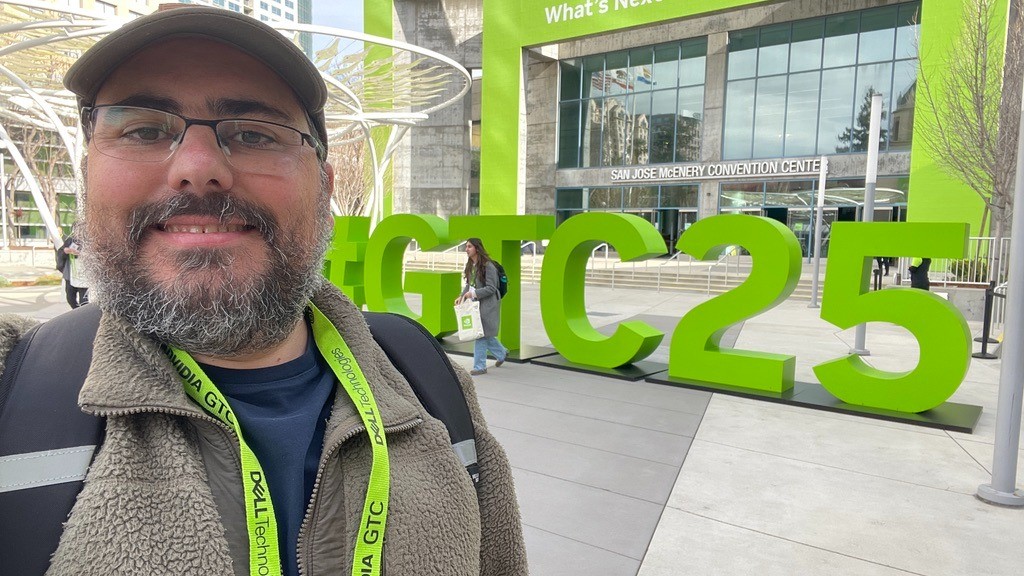
I’ve written a detailed 3-part series covering this conference:
- Part 1: Keynote and Main Announcements - Jensen Huang’s keynote, Rubin hardware reveals, and key product announcements
- Part 2: Deep Dive into CUDA - CUDA workshops, CuTile paradigm, and comprehensive CUDA-X libraries reference
- Part 3: Exhibit Hall - Hardware and Robotics - Server infrastructure, GB300 hardware, liquid cooling, and robotics demos
Main Conference Highlights
- Jensen Huang’s keynote address with a live Acquired podcast
- “CUDA, New Features and Beyond” session announcing CuTile programming paradigm
- Deep-dive CUDA sessions on bandwidth, latency, compute optimization, and kernel writing
- Four-hour C++ workshop using the Thrust library
- GPU acceleration for Apache Spark with Project Aether for job migration
- Extensive exhibit hall showcasing hardware, robotics, and medical equipment
Keynote Takeaways
Huang emphasized that accelerated computing continues displacing CPU-only applications across hard sciences, wireless communications, industrial robotics, and enterprise AI. Key announcements included:
- Next-generation hardware: Vera Rubin NVL144 (2026) and Rubin Ultra NVL576 (2027)
- Architecture roadmap: Feynman architecture following current generation
- New products: Isaac Groot N1 humanoid model, Newton physics engine, Grace-Blackwell DGX systems
- Interconnect innovation: Photonics-based Spectrum-X for scaled clusters
Data center energy constraints and agentic AI demand (requiring “10-100x more compute”) were identified as major growth drivers.
Read the full keynote coverage with photos in Part 1
Key Technical Sessions
CUDA C++ Workshop
Participants built a multi-body heat dissipation solver using Thrust library, learning about asynchronous copying, pinned memory, CUDA streams, and Nsight Systems debugging tools.
CuTile Programming Paradigm
A new abstraction layer allowing developers to think in terms of tiles rather than threads and clusters, promising “shorter and clearer expression of the computation.”
Ecosystem Expansion
Sessions highlighted GPU-accelerated replacements for common Python tools: RAPIDS cuDF (pandas/Polars), cuML (scikit-learn), and cuPyNumeric (NumPy).
See Part 2 for detailed CUDA content and complete CUDA-X libraries table
CUDA-X Libraries Summary
The conference covered comprehensive GPU-accelerated libraries across categories:
Math Libraries: cuBLAS, cuFFT, cuRAND, cuSOLVER, cuSPARSE, cuTENSOR, cuDSS
Data Processing: RAPIDS (cuDF, cuML, cuGraph), cuVS, NeMo Curator, Morpheus, GPU Direct Storage
Image/Video: cuCIM, CV-CUDA, DALI, nvJPEG, Optical Flow SDK
Deep Learning: TensorRT, cuDNN
Quantum: cuQuantum, cuPQC
Communication: NVSHMEM, NCCL
Exhibit Hall Observations
The exhibit space demonstrated current hardware capabilities, including:
- Liquid-cooled racks consuming 150KW+ (air cooling no longer viable)
- GB300 compute boards and NVLink switching infrastructure
- Humanoid robots and exoskeleton demonstrations
- Autonomous grocery shopping robots
Explore Part 3 for detailed exhibit hall photos and hardware specifications
Venue and Attendance
The conference expanded beyond the convention center to nearby civic theaters and park spaces due to increased attendance. There was a mile long line for the SAP Center keynote, with some sessions reaching capacity.
Conclusion
The conference was energetic and well-presented, with valuable networking opportunities among industry practitioners. The exhibit hall even had a digital fitting room demonstration, where I virtually tried on Jensen Huang’s signature black leather jacket.
Read the complete 3-part series: