On Pope Leo XIV's Letter on Artificial Intelligence
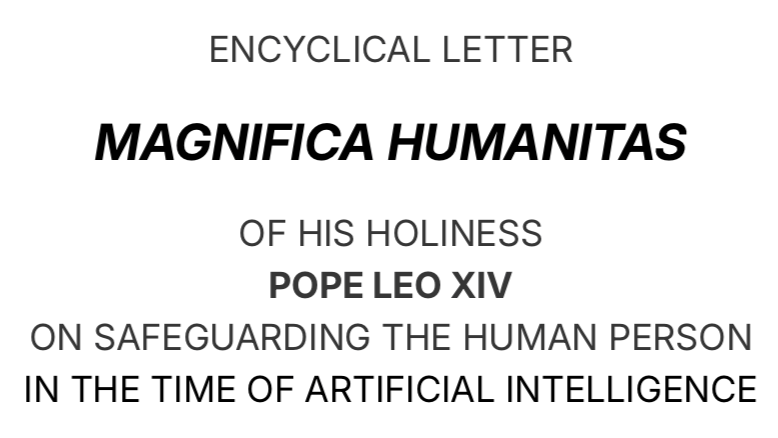
On May 15, 2026, Pope Leo XIV released an encyclical letter expressing his thoughts on Artificial Intelligence for all of us to reflect on. This couldn’t have come at a better time, because today more than ever, the fast development of AI technology has been challenging me to reflect more deeply and with more urgency on what are the most important things to focus my life on, as a parent, a citizen, an engineer. I would thus like to relay his letter and offer some of my thoughts, especially on the first half of it, and in the humble spirit that claims no full knowledge of the truth.
The letter is long but worth a read. In it, Pope Leo XIV challenges us to think about whether the promise of AI technology will be pursued under the delusion of human infallibility and self-sufficiency or in the spirit of an authentic and responsible stewardship that honors and preserves. Rather than humans sacrificing their dignity and being subservient to technology, it is technology that must be directed to serve human dignity. The pope thus spends a good portion of his letter explaining the main principles developed by the Catholic Church to honor and preserve the dignity of every human being, the principle of common good, of universal destination of goods, of subsidiarity, of solidarity, and of social justice. “The fundamental dignity of each person, therefore, is neither acquired nor earned, nor does it need to be justified [..] Every human person possesses an infinite dignity, inalienably grounded in his or her very being, which prevails in and beyond every circumstance, state, or situation the person may ever encounter” [53]. The same spirit pervades the sacred American creed written 250 years ago, that all “men are created equal, that they are endowed by their Creator with certain unalienable Rights, that among these are Life, Liberty and the pursuit of Happiness”.
Today, the challenges facing humanity are immense because society is dominated by the modern technological way of being. In order to confront this reality, we must be clear-eyed about what technology truly is, not the sum of all created technical things but a reflection of our own modern way of revealing the world, our “tendency to let the logic of efficiency, control, and profit alone shape personal, social and economic decisions”[92](emphasis mine). A new historical reality has set in, one in which the dominant actors driving these technological breakthroughs are private corporations large enough to mediate almost all societal interactions and with enough financial resources to bend the democratic system in their favor. As Pope Leo XIV says, “In many cases within the digital context, control over platforms, infrastructure, data and computing power does not rest with States, but with major economic and technological actors. These entities effectively set the conditions for access, determine the rules of visibility and shape the very possibilities for participation. When such power is concentrated in the hands of a few, it tends to become opaque and evade public oversight, increasing the risk of distorted forms of development that give rise to new dependencies, exclusions, manipulations and inequalities.”[95]
The impending arrival of what is now called Artificial General Intelligence (AGI) technology has been dazzling the world, feeding its craving for unlimited superhuman capabilities on demand, but at the same time auguring an era that deeply questions the role of humans in society. Pope Leo XIV warns us not to confuse artificial intelligence with human intelligence and not to succumb to the hubris of the Tower of Babel. AI systems are very useful but they are not human. They “do not undergo experiences, do not possess a body, do not feel joy or pain, do not mature through relationships and do not know from within what love, work, friendship or responsibility mean. Nor do they have a moral conscience, since they do not judge good and evil, grasp the ultimate meaning of situations, or bear responsibility for consequences”[99]. All that AI is trained to do is to imitate language and simulate empathy and understanding. It feels nothing, it is simply a cold and empty “form of statistical adaptation based on data and feedback, which can be very effective, but does not imply inner growth”. The distinction between human and artificial intelligence is so fundamental that it ought not even be questioned, and yet here we are so lost to technological thinking that this fact is no longer “obvious” and needs to be argued. In the letter, the pope has a message of vigilance for those developing this technology because he understands technology is not a morally neutral instrument. All human creations embody in them the values of their creator. “Every technical tool embodies choices and priorities through what it measures, ignores and optimizes, and how it classifies people and situations.”[104] And for this reason, with AI even more than any other technology, it is important to understand and “examine how that system is designed and what vision of the human person and society is embedded in the data and models that guide it” [104]
Pope Leo XIV uses the provocative concept of Disarming AI to wake us up to the reality of a race to the bottom in an AI-weaponized world with catastrophic consequences. This expression brings our mind back to the time when the atomic bomb was detonated to end WWII and destroyed countless lives in the most horrific way possible. Shortly after humanity realized that it had created a technology that could bring it to its end. The evident potential for mutual destruction and annihilation were so overwhelming that they awakened global consciousness and sustained the movement to disarm nuclear weapons during the Cold War. We have not yet seen today’s AI Hiroshima moment. Still in the future lies the threat of uncontrollable autonomous AI weapons or society-wide AI automation leading to massive unemployment and breakdown of social relations. These dangers are much discussed today, but there is one more that the pope emphasized which I really appreciate, one that is much less talked about and less conceptualized. This is the subtle but slower and more profound way AI will impoverish our human existence as it presents itself as the ultimate possibility of liberation from human suffering. Trans-humanism and post-humanism [116] are today’s ideologies pushing furthest in this direction. In reality if left to seep through society without any sense of the impending danger, AI technology will turn out to be the biggest challenge to the human creative spirit and pursuit of happiness.
All my readings and experience indicate to me that for millennia now, from the early greek philosophical writings, to the first century apostolic gospels and epistles expressing the radical Christian message, to the 20th century modern existential philosophies responding to the calamities of two World Wars, human being at its core has been understood to mean overcoming a fallen, average, and dispersed absorption in worldly matters. But overcoming how? Certainly not by removing the body altogether and replacing it with a machine (or by escaping to Mars), but overcoming by a process of resolutely taking up the responsibility for our ownmost possibilities, freed to face the anxiety of our finitude, embedded in our communities, rooted in a place of belonging, and from the Christian point of view grounded in the unity of being that is God. The most optimistic supporters of AI will have us all believe our salvation lies in a human created technology. Pope Leo XIV, however, understands this not to be true, that there is no final solution to the problem of human existence, that the danger lies in thinking that there is, that instead it falls as a task to every generation to renew human existential possibilities and make them available to the largest number of people: “I am convinced that the concrete way of living out social relationships in the light of the Gospel is not established once and for all, but remains a task entrusted, from generation to generation, to the Christian community.”
There is more in this letter that is worth pondering and I hope to touch on in future posts after more reflection and reading. I would just like to close with the special message that Pope Leo XIV addressed to developers and engineers working on the development of AI technology, and I would say in technology in general and not just as engineers, whether in Silicon Valley or around the world, that is worth asking oneself about (emphasis mine):
“I wish to address a special appeal to those who develop artificial intelligence. In one sense, technological innovation can represent human participation in the divine act of creation. Developers, therefore, bear a particular ethical and spiritual responsibility, for every design choice reflects a vision of humanity. Just as the creator of an artistic or literary work must consider the values it conveys, so developers are called to embed values in their projects with due seriousness: with transparency, responsibility toward affected communities and careful attention to ensuring that what is being cultivated is a genuine good” [111].
Encyclical Letter, Magnifica Humanitas
Short speech by the pope summarizing his thoughts on Disarming AI